Civil War veteran, GAR member, lived out his life in South Hannibal
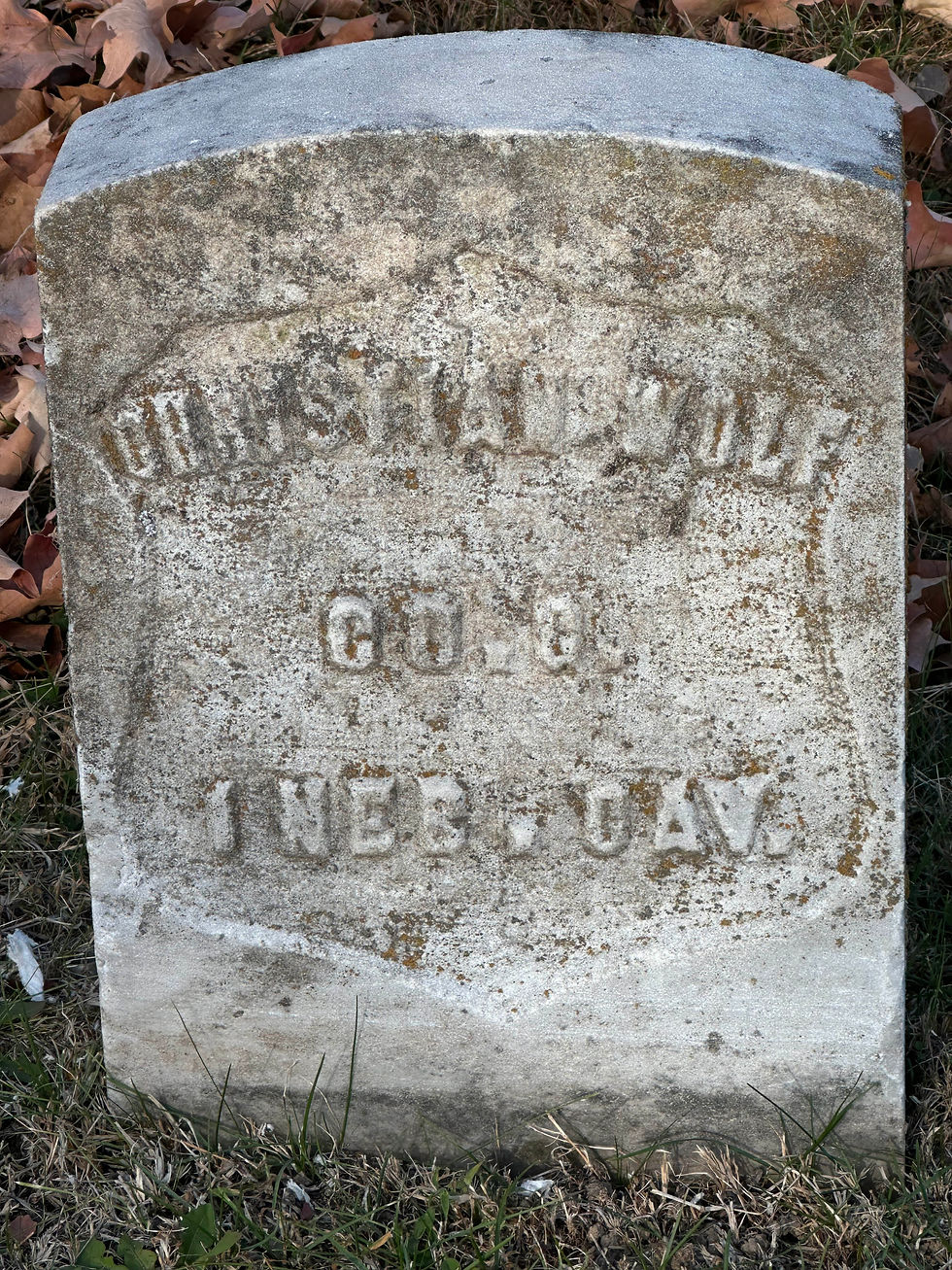
The white marble headstone attached to the grave of Christian Wolf at Mount Olivet Cemetery was supplied by the U.S. Government. Wolf was a member of the William T. Sherman Post 43, Grand Army of the Republic, which did research on behalf of the government to locate and subsequently mark graves of old soldiers. Photo by Meryle Martin Dexheimer.
MARY LOU MONTGOMERY
At the beginning of the 20th Century, members of the William T. Sherman Post 43, Grand Army of the Republic, did much of the legwork required to locate and identify the gravesites of Hannibal-area Civil War soldiers.
The GAR members - Union Army veterans - assisted with a government program, designed to place stately white marble headstones - at the government’s expense - upon old soldiers’ graves. The program was reliant upon the volunteer efforts of organizations such as the GAR in order to locate the graves and document the military service.
A mention of this program, contained within the June 27, 1903, edition of the Hannibal Morning Journal (newspapers.com) explained that volunteers were having “considerable difficulty in securing the particulars required by the government. The government requires that the name of the deceased in full, the company and regiment to which he belonged, the time of his discharge, the date of his death and the name of the cemetery in which the remains were buried.”
At of the end of June 1903, “William T. Sherman Post has been engaged in ascertaining the names of those buried in the Hannibal cemeteries for several months past and the first shipment (of tombstones) will be made some time in July.”
The first stones to be installed, according to the Sept. 5, 1903 edition of the Hannibal Weekly Journal, were for:
Cyrus Kidd, Second Calvary, Riverside Cemetery;
John Swartz, Company F, Riverside Cemetery; and
Clarence Morgan, Company F, Baptist Cemetery.
Once the markers were in place, each May the GAR members decorated the graves of these veterans for Memorial Day (aka Decoration Day).
In May 1905, committees were set up by the GAR chapter to decorate the graves in cemeteries in and around Hannibal.
On the decorating committee:
Mount Olivet cemetery: A.W. Bulkley, Madison Turner and Christian Wolf.
Brown’s Cemetery: Jacob Hollenberger.
Riverside Cemetery: B.F. Fields, C.A. Willoughby, J.B. Shepherd and J.M. Bright.
Baptist Cemetery: Alexander Smeathers and Edward Gott.
St. Mary’s Cemetery, T.J. Higgins, Pat Gurry and Pat Glenn.
Antioch cemetery: William Harding.
Marble Creek: Reuben St. John.
The Morning Journal on Aug. 29, 1903, offered a frank description of the aging members of the GAR:
“The old soldiers of the war of 1861 are rapidly dropping out, responding to the last bugle call and in a few more years none will be left to tell of the thrilling incidents of that unpleasantness. There are now very few of them under sixty years of age and a majority are at least 10 years older. Their heads are silvered over by the frosts of many winters and their steps are slow and tottering. They are fast marching on to their last camping grounds.”
A few of the members of the William T. Sherman GAR chapter, as culled from newspapers of the day:
R.E. Anderson
Dr. A.R. Ayers
J.M. Bright
Alfred W. Bulkley
W.F. Chamberlain
I.M. Cramer
Benjamin F. Fields
Col. Ginger
Pat Glenn
Edward Gott
Pat Guersy
Pat Gurry
William Harding
T.J. Higgins
J.O. Hogg
Jacob Hallenberger (or Hollenberger)
Judge Knoepfel
R.S. John
C.J. Lewis
T. McCaskey
L. Matteson
W.S. Peck
L.W. Preston
Thomas Rollo
Reuben St. John
J.B. Shepherd
Alexander Smeathers
John Stewart
John Stillwell
Alex Smeathers
Madison Turner
C.A. Willoughby
Christian Wolf
South Hannibal veteran
One of the members of the local GAR chapter was Christian Wolf (1836-1908), a German-born laborer who moved to Hannibal prior to the onset of the Civil War. He served out his tour of duty on behalf of the Union Army, and subsequently lived out the remainder of his life in South Hannibal.
Throughout his life he was no more than a common laborer, but he managed to raise a family and become a homeowner - with extended family nearby - in a proud blue-color neighborhood.
Christian Wolf moved from his parents’ home in Pennsylvania and headed west prior to the onset of the war. By the time of the 1860 census, he was a resident of Hannibal, married to Johanna Daack Wolf, and they had an infant son, Georgie.
A year later, Christian Wolf was committed to fighting for his adopted country. On June 30, 1861, he enlisted as a private, according to available records, serving with the 1 Nebraska Infantry, Company G. He served until his discharge on July 1, 1866.
Back home in Hannibal, he lived with his family in various locations during the 1870s, including Lime Kiln Hollow.
By 1879, the young family was settled comfortably onto Valley Street in South Hannibal, where both Christian and Johanna would live out their lives. Valley is literally located in the valley parallel to Union on the east and Park on the West. Their home was originally numbered 1079 Valley, and in 1912 was renumbered 1404 Valley.
That house, a small frame structure on the east side of Valley, between Peyton to the north and West Chouteau, (platted, but not open) to the south, remained in place until 2023, when it became casualty of fire.
Christian and Johanna Wolf were parents to at least three children:
George Wolf, 1859-1889; married to Emma A. Huckey (1859-1927);
Christina Wolf, 1863-1960; married in 1890 to John S. McRae (1858-1911); and
Emma Wolf, 1869-1926; married in 1887 to Charles E. Sanders (1861-1941).
Christian and Johanna Wolf were members of the First Methodist Church, 901 Broadway, at the time the church building was dedicated, June 23, 1907. (That building now serves as home to the Hannibal Music Academy and Performance Hall.)
Johanna Wolf, left a widow upon her husband's death in 1908, subsequently married Hans Christian Melchertson (born in Denmark in 1848, died in Hannibal.) When they married in 1910, he was a foreman for the St. Louis and Hannibal Railroad, and had previously lived at 1333 Collier. Johanna and Hans lived together at 1404 Valley until her death in 1924.
(He had previously been married to Anna Wetherall Melchestson [1861-1900] and they made their home in Louisiana, Pike, Mo. They had one daughter, Marie Melcheston.)
Daack family
Johanna was a sister to August Daack (1846-1915), who lived in Hannibal for a time in the early 1900s. His primary home was Calhoun County, Ill., where siblings and extended family members lived. August Daack, like his brother-in-law, served during the Civil War, with the G 1 Nebraska Calvary.
August Daack was married to Matilda Nevill Marshall (1857-1910) in 1906. Matilda’s father was Charles E. Nevill (1818-1891) who lived at 220 Ely, Hannibal, in 1888. Also living at 220 Ely in 1888 was Matilda’s brother, Charles T. Neville Jr., a laborer for D. Dubach and Co.

Christian Wolf, a Civil War veteran, returned to Hannibal after the war, and for most of the remainder of his life lived in a small frame house, ultimately numbered 1404 Valley St. The house burned in 2023. His house was south of the intersection of Valley and Peyton streets. Photo by Robert Spaun.

Christian Wolf is buried in Section 8, Lot 27, Mount Olivet Cemetery. He died in 1908, at the age of 72. He has two tombstones, one denoting his service during the Civil War, and the other, a family momument, engraved with the sentiment: Gone but not forgotten. Photo by Meryle Martin Dexheimer.
Mary Lou Montgomery, Suburban Newspapers of America Editor of the Year, Dailies, 2010, retired as editor of the Hannibal (Mo.) Courier-Post in 2014. She researches and writes narrative-style stories about the people who served as building blocks for this region’s foundation. Books available on Amazon.com by this author include but are not limited to: "The Notorious Madam Shaw," "Pioneers in Medicine from Northeast Missouri,” “Hannibal’s ‘West End,’” “Oakwood: West of Hannibal,” and “St. Mary’s Avenue District.” Montgomery can be reached at Montgomery.editor@yahoo.com Her collective works can be found at www.maryloumontgomery.com


Comments