On the circuit with the original Virginia Ravens
MARY LOU MONTGOMERY

Maceo Wilson was pictured in the “The Call” newspaper on July 20, 1956. newspapers.com
Maceo Wilson, born in November 1896, was but a wisp of a man, standing just a tad over 5-feet-4 at his maturity. But the Hannibal native was none-the-less considered to be a musical giant during his day, his talents shining far beyond his hometown of Hannibal, Missouri.
In March 1916, during the months leading up to his graduation from Hannibal’s Douglass High School, he was already demonstrating a recognized prowess in the music field. He was invited by the school’s revered orchestra leader, Prof. Martin Lewis (1873-1945), to present a cornet solo at the Sixth Street AME Church in Prof. Lewis’ hometown, Louisiana, Mo.
The concert, staged on March 10, 1916, also included a vocal solo by Frank Lewis of Hannibal (possibly the man of the same name who was a 1906 graduate of Douglass High school); and a solo by Mrs. Anna Henley, a Douglass teacher (widow of Henry), who sang, “Somewhere a Voice is Calling.”
Accompanying the musicians on this trip to Louisiana, according to a newspaper article published in the March 24, 1916 edition of the Topeka Plaindealer, was Sylvia Cotton, daughter of Jennie Sanders Cotton. Sylvia would go on to graduate from Douglass High School in 1917. Maceo and Sylvia would marry in September 1918, prior to Maceo’s deployment for military service during the first World War.
‘Virginia Ravens’
Ten years after this noteworthy concert in Louisiana, Mo., and after a short stint with the U.S. Army, Maceo Wilson became a leading member on the midwestern music scene, as manager of the 10-piece band, the “Virginia Ravens.” According to the St. Louis Argus newspaper in its Jan. 22, 1926 edition, five of the band’s members, including Maceo Wilson, “are Hannibal boys of the Douglass School Band, who had received their literary and musical training from Prof. Martin Lewis of the Hannibal colored high school.”
At the time of the newspaper mention, the Virginia Ravens had been touring the states of Iowa, Minnesota and Illinois, “playing to large enthusiastic audiences.”
The orchestra
The Virginia Ravens were classified as a colored orchestra, performing primarily one-night stands on a circuit across the Midwest.
Note: In 1926, the word “original” started to appear in newspaper promotional ads, suggesting that there might be a copycat group performing under the same name. When compiling this article, the author reached the conclusion that Maceo Wilson was a leader for the “original” Virginia Ravens. The following news snippet from the Brookfield Argus and the Linn County Farmer of March 29, 1930, lends support to that conclusion:
“Look who is coming. The red hot original Virginia Ravens of Hannibal. One of the best dance bands of North Missouri will play at the Arcadia Hall, Brookfield, Tuesday night. Benefit for the Security Benefit Association and Council No. 17. Admission gents $1.00. Ladies free.”
Band members
While no comprehensive listing of the members of the “original Virginia Ravens orchestra” could be discerned through a search of newspapers of the era, snippets of information were culled from local listings, offering hints as to who some of the band members were.
The Muscatine Journal of Sept. 15, 1924, identified Virginia Ravens orchestra members who were involved in an automobile accident Friday night, Sept. 12. Band members were returning to Muscatine following an engagement when the car hit a rut, the newspaper reported, and went into a ditch, before overturning. All the band members were pinned under the car. Band member A.E. Douglas was seriously injured. Others injured were listed as Clyde Frear, Robert Robinson, Alfred Thompson and Eddie Mallory. Injuries ranged from serious to slight.
1925: Mr. Todd Milton Drew (1895-1949) of Columbia, Mo., was on tour with the Virginia Ravens Orchestra in November 1925, when the musicians were booked in St. Paul, Minn. He was the guest there of his aunt, Mrs. Addi Bellesen. His mother, in Columbia, Mo., was Mrs. Lula Drew.
1925: “Mrs. Queen left the Richmond hotel (in Lancing, Mich.) last week to join her husband, who is playing with the Virginia Ravens.” (Chicago Defender, Nov. 7, 1925.)
1926: Police raided the pavilion on the southwest shore of Pike Lake on Thursday, Aug. 12, 1926, and five members of the Virginia Ravens orchestra were arrested upon the complaint made by some young white women in the audience. Taken into custody were Jerry Blake, Eddie Mallory, Harold Winnings, Clarence Greer and Jimmie Williams. (Lansing State Journal Aug. 13, 1926.)
1926: “The Virginia Ravens, playing at Pine Lake summer resort, are making good. The past week Dave Peyton, one of the leaders of Chicago’s orchestral family and writer for the World’s Greatest Weekly, paid high tribute to the Raven orchestra and also Ed Mallory, cornetist, of whom Peyton is a close friend.” (Chicago Defender, Aug. 14, 1926)
1926: “The famous Virginia Ravens are in Hannibal on their vacation, this being their home. Prof. Maceo Wilson, director.” (Chicago Defender, Sept. 25, 1926.)
1926: “The Virginia Ravens orchestra is now the big feature at the Tuxedo cafe, Davenport, Iowa. The bunch are favorites in the dance hall area of Illinois, Michigan and Wisconsin. Last summer unpleasant difficulties confronted the orchestra. They split up and have recently been reorganized under the direction of Jack Moore, a very capable musician.” (Chicago Defender, Nov. 20, 1926)
1926: “Bertram Dillard, cornetist, was playing in Rockford, Ill., with the Virginia Ravens.” (Chicago Defender, Dec. 25, 1926.)
1927: Maceo Wilson was identified by the St. Louis Argus as the director of the Virginia Ravens in January 1927. The orchestra was based, the newspaper said, at Rockford, Ill.
1927: “Lee Lancaster, formerly with the J. Rosamond Johnson act in vaudeville, is now chirping with the Virginia Ravens. Mail will reach Lee at General Delivery Rockford, Ill.” (Chicago Defender, March 12, 1927)
1927: “Tonight the Virginia Ravens, a high class colored orchestra, will play for the opening of the Seaton (Illinois) dance pavilion. This orchestra which numbers ten, is one of the finest that has played in this part of the country.” (Daily Review Atlas, April 26, 1927.)
1927: Clarence Greer, identified as a member of the Virginia Ravens orchestra, died in an automobile accident at Flint, Mich., Sunday night, July 20, 1927. According to the published accident report, he was a featured headliner with the band when it performed at Riverview Pavilion in Muscatine, Iowa, on Aug. 6, 1924.
1927: “Mocking bird Bob Howe is now playing with the Virginia Ravens orchestra.” (Chicago Defender, Sept. 17, 1927.)
1927: “Grear’s Midnight Ramblers, formerly known as the Original Virginia Ravens, are closing their engagement in Wisconsin and will go directly to West Virginia, where they will play the dance field for the winter.” (Chicago Defender, Nov. 12, 1927)
1927: “Bert Dillard is a member of the Virginia Ravens orchestra and toots the trumpet with that well known musical unit.” (Chicago Defender, Feb. 19, 1927)
1927: “The park season will open here Sunday when Indian Mound Park (Quincy, Ill.) will formally open to the public. A concert by the Virginia Ravens is scheduled for the evening.” (Quincy Herald Whig, May 27, 1927)
1928: Esque Douglas of Hannibal and Mexico, Mo., W. J. Webb of Lafayette, Ind., and Boyd Rosser of Cincinnati were among the members of the Virginia Ravens Orchestra that played at the Arkata dance hall, Sioux Falls, S.D., last week. (The Enterprise, Seattle, Wash. July 12, 1928.)
1929: Maceo Wilson told a reporter for the Hannibal Courier-Post, during an interview for a 1973 edition, that the Virginia Ravens band disbanded in 1929.
Regional attraction
The end of Maceo Wilson’s traveling jazz band career served as the beginning of his regional draw.
1929: “Maceo Wilson, a Hannibal colored man, who has appeared many times before the microphone in station WHO, gave several banjo solos, accompanied by Larry Inghram at the piano. The gifted fingers of the performer brought sweet music from the banjo as he played “Waiting for the Sunrise,” “Can’t Be Wrong,” “Chinese Honeymoon” and other numbers. (The Palmyra Spectator, in its Jan. 23, 1929 edition.)
Maceo continued to both entertain and to teach music for years to come. He was the long-time pianist for the Second Christian Church located at 1616 Broadway, and taught music lessons out of his home, which was located at 206 Olive Street.
Musicians remember
Among his pupils were two members of the Baby Boomer generation who are still utilizing the music skills learned from the master: Gregg Andrews, of San Marcos, Texas, and Jacqua Brown-Williams, of Dallas, Texas.
Maceo died in February 1974.
His wife Sylvia, died in 1984.
They are buried in Hannibal’s Robinson Cemetery.
Band member summary:
Blake, Jerry
Dillard, Bertram
Douglass, A.E.
Douglas, Esque, Hannibal, Mo.
Drew, Todd Milton
Frear, Clyde
Greer, Clarence
Howe, Bob
Lancaster, Lee
Mallory Eddie
Moore, Jack
Robinson, Robert
Rosser, Boyd, Cincinnati, Ohio
Thompson, Alfred
Webb, W.J., Lafayette, Ind.
Wilson, Maceo, Hannibal, Mo.
Williings, Jimmie
Winnings, Harold
Queen, Mr.

The Leader Telegram, Eau Claire, Wis., published an advertisement for the original Virginia Ravens in its July 17, 1927 edition. newspapers.com

The Hannibal Evening Courier-Post published an announcement regarding the establishment of the Woodson Post, American Legion, in its Sept. 26, 1919 edition. Maceo Wilson was the organization’s first commander. newspapers.com

The Second Christian Church, located at 1616 West Broadway, Hannibal, Mo., on Aug. 11, 1933. For a number of years, Maceo Wilson served as the church pianist. Herring Studio photo; J. Allen Ballard, identifier. Hannibal Free Public Library collection.
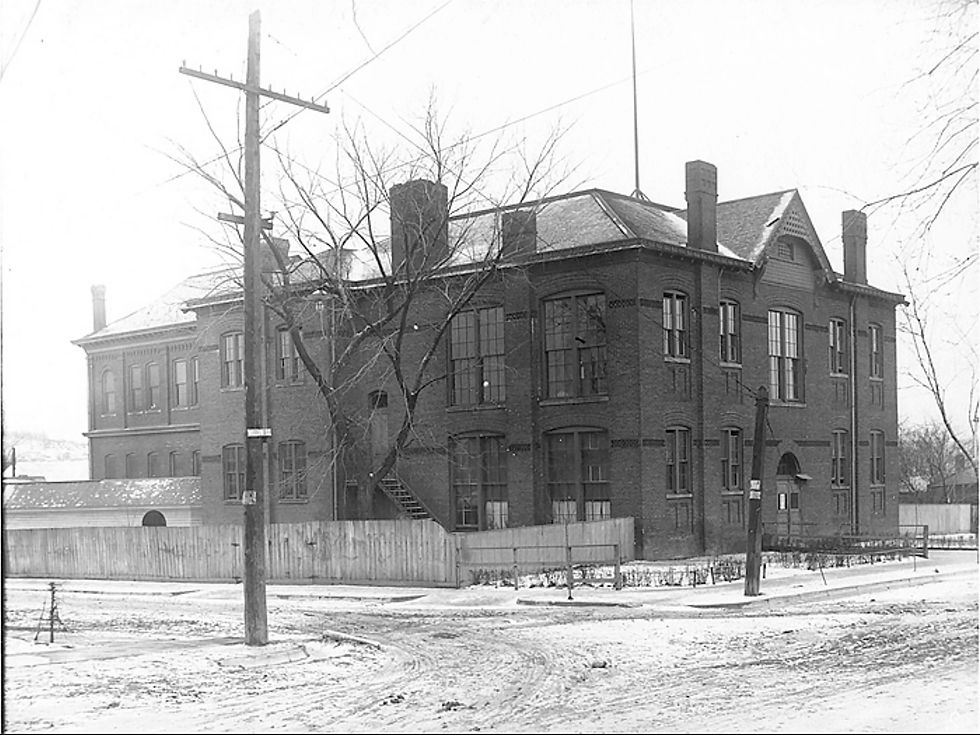
Douglass School, located on what is now Willow Street in Hannibal, served African American students from throughout Northeast Missouri during the years of segregation, from the 1870s until the mid 1950s. Photo courtesy of the Hannibal Free Public Library.
Mary Lou Montgomery, Suburban Newspapers of America Editor of the Year, Dailies, 2010, retired as editor of the Hannibal (Mo.) Courier-Post in 2014. She researches and writes narrative-style stories about the people who served as building blocks for this region’s foundation. Books available on Amazon.com by this author include but are not limited to: "The Notorious Madam Shaw," "Pioneers in Medicine from Northeast Missouri,” “Hannibal’s ‘West End,’” “Oakwood: West of Hannibal,” and “St. Mary’s Avenue District.” Montgomery can be reached at Montgomery.editor@yahoo.com Her collective works can be found at www.maryloumontgomery.com


Comments