1901: Hannibal prepares for Mid Summer Carnival

Publicity illustration from the Canton Carnival Company, published in the Hannibal Morning Journal, Saturday, June 8, 1901. newspapers.com
MARY LOU MONTGOMERY
A mid-summer attraction, the likes of which had never before been experienced in Hannibal, was about to come to fruition, following an agreement signed on June 1, 1901, between Thomas Robinson, president of the Hannibal Street Fair Association, and the Canton Carnival Company.
The scheduled event - said to be modeled after the Pan American Exposition Midway, was to be open from July 15-20, at stages set up throughout Hannibal’s business district.
Wikipedia reports that the year 1901 was a “major boom period for the street fair and traveling carnival industry.” The stop in Hannibal was unique, because it was believed to be the first time that such a carnival company had ventured as far west as Missouri.
The key concept behind this business venture was to attract people from the outlying region into Hannibal, serving as an economic boost to local merchants.
In preparation, the executive committee of the Street Fair Association requested via the July 12 edition of the Hannibal Morning Journal that every merchant and property owner to clean up the street in front of their places and keep same clean as possible during the week of the carnival. “This is of the utmost importance if we wish to make a good impression upon the crowds of visitors which we expect to entertain. Let us make a day of it Friday and everybody get to work and clean up.”
Negotiations by the Hannibal Street Fair committee arranged for free passage across Hannibal’s bridge, as well as ferry service from Illinois, and free passage on the toll roads coming into Hannibal. In addition, rail service into Hannibal during the festival week was discounted.
According to the July 14, 1901 edition of the Hannibal Morning Journal, the Canton Carnival Co., was to leave Alton, Ill., at 10 o’clock that morning, via the K line, on a special train for Hannibal. The train, in turn, was expected to arrive locally at 8 p.m. The train consisted of 13 cars, including three coaches for the accommodation of the employees of the company.
The Champaign Daily Gazette, Champaign, Ill., on July 3, 1901, reported: “The Canton Carnival company carries nearly 300 performers and working people with it, twenty cases of trained animals and a large number of attractions which have not been seen in this section of the country till the present season, since the close of the world’s fair. It is the aim of this company to reproduce the famous Midway of the World’s Fair.”
Town is ready
The the day prior to the festival’s start brought a round or readiness from all involved.
The Hannibal Morning Journal of July 14 reported:
“Everything is in readiness for the opening of the grant carnival tomorrow afternoon.
“The arches have all be wired and the current was turned on last night, and the effect was glorious. Hannibal is built just right for a street fair. Colonel Conley, of the Canton Carnival Company, stated last night that Hannibal, in the matter of property and artistic preparation, surpassed any city he had visited this season.
“The administration building surrounding the arches illuminated with brilliant incandescent lights presented a pretty picture last evening.
“The streets India, located on Fifth street, are all ready for occupancy. The lights are in position, and it will require but a short time to have them open and ready for business when the shows arrive. Performances will be given in this enclosure twice a day, at 3 o’clock in the afternoon and 9 o’clock at night. The high dive act will take place there.
“The frame work and stages for the other attractions are in position.
“The carnival will open in a blaze of glory Monday evening.
“Reports from the surrounding country indicate a big attendance during the week.
“President (Thomas) Robinson and Secretary (L.E.) Turner were at headquarters last night to greet all visitors.
“President Robinson requests the business men to decorate their premises with carnival colors as early tomorrow as possible. Everybody should turn out tomorrow night and give the carnival a credible opening.
Electric fountain
A highlight of the six-day festival was a portable electric fountain, said to have been exhibited at the Omaha Exposition. The fountain, “throwing a stream of water 60 feet high in the air,” was located on a platform under the great central arch at the corner of Main and Broadway. “Lights of various colors are flashed on the water with exquisite effect. Displays every half hour after eight o’clock at night.” (Hannibal Morning Journal, July 16, 1901) In the next day’s edition, the Morning Journal noted: “The fountain charmed everybody.”
Attractions
Trained wild animal show
The Ferris Wheel\The Electric Theatre
The high divers
Streets of India (At Fifth and Broadway)
The German Village (At Church and South Main)
Streets of Cairo
The Flying Lady
Temple of Art
Congress of Dancing Girls
The Great Phlion
The Electric Fountain (At Main and Broadway.)
Achille Philion, the marvelous Equilibrist and Originator
Dana Thompson, billed as “the world’s highest diver,” was to wow fans by making a sensational somersault dive from a 105-foot ladder into a tank of water but three feet in depth.
Carnival colors
As a special promotion, carnival colors chosen were red, yellow and apple green, to be used in all decorations.
Merchants were asked to decorate their windows in these carnival colors. “Window decoration is one of the things especially and peculiarly in evidence in preparation for the street carnival and merchants are making an effort to (outdo) each other in display. And the result will be that the show windows of business houses never before had on such holiday attire as those in Hannibal.”
In keeping with the carnival’s color theme, “Quite a number or young ladies of the South Side have had their hats trimmed in colors of the carnival,” the Hannibal Weekly Journal reported on July 20, 1901, “and of course they are quite pretty,” the newspaper noted, referring to the young ladies.
Throughout carnival week, Milton Strong Dry Goods Co., advertised red, green and yellow merchandise, in the carnival colors, at 3 1/2 cents per yard.
A daily parade took place on the streets of Hannibal, consisting of Canton carnival employees and animals, including musicians, and people of all nationalities.
Motorcycle
An attraction that garnered much attention wasn’t an attraction at all. The Hannibal Morning Journal on July 16, 1901, reported that Prof. Philon, “who performs on the spiral ladder, one of the free attractions of the Canton Carnival Company, is the owner of a motorcycle, and travels from one town to the other on it. He arrived from Jacksonville (Ill.) Sunday morning and attracted considerable attention while riding about the street.”
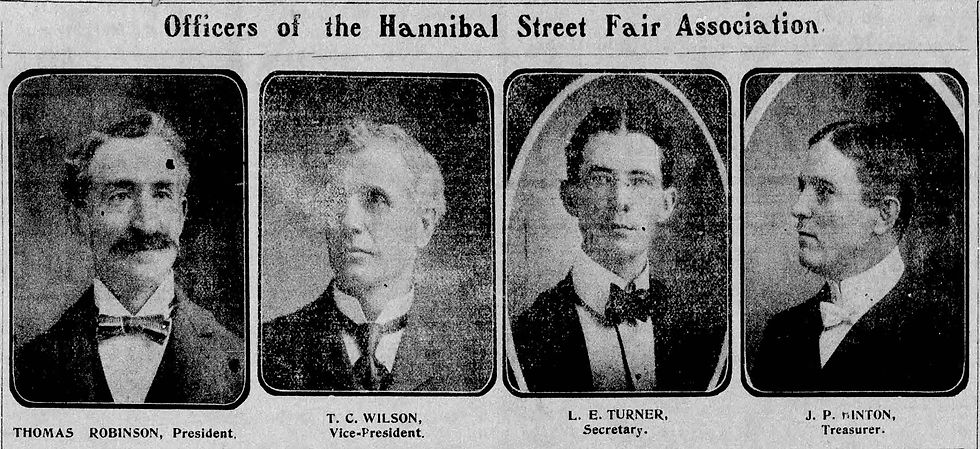
Street fair officers
Thomas Robinson, Robinson Bros., furniture, wall paper, paints, oils, glass and artists materials, 118-122 S. Main, president;
T.C. Wilson, real estate, insurance and loans, 117 Broadway, vice president;
L.E. Turner, secretary and treasurer of A.J. Stillwell Meat Co., secretary; and
J.P. Hinton, cashier, Bank of Hannibal, and president of Storrs-Hinton Ice and Coal Co., treasurer.
Note: Thomas Robinson, born in Ireland in 1848, is Mary Lou Montgomery’s great-grandfather. He was business partners with his twin brother, Robert Robinson.


Comments