As autos became main stream, J. Frank Cox’s family adapted

Shown are the former house, at left, and filling station owned by the J. Frank Cox family for many years on Fulton Avenue, nearby the old Burlington Railroad yards. The properties were torn down following the flood of 1993. Steve Chou photo.
MARY LOU MONTGOMERY
A 17-year-old who was rabbit hunting atop Lover’s Leap on Feb. 7, 1916, narrowly escaped death when he stumbled and subsequently tumbled part-way down the steep rocky cliff toward the area near the railroad yards below.
Enes L. Cox’s fall was broken by a small bush on the side of the cliff, which caught him and prevented his full descent down to the street below.
The Hannibal Morning Journal reported in the next day’s edition: “He slid and rolled down the steep bank but a small bush arrested his fall. Here he hung, unable to climb back to the top of the bluff and unable to descend to the road below.
“He called for assistance and O.S. Knopp, Mr. Fitzpatrick and several other members of the Burlington repair yard force, secured rope and going to the top of the cliff lowered the rope to the youngster. The youth was almost frozen when he was drawn to the top of the cliff. He sustained a broken nose, the only injury in his perilous plunge.”
Enes Cox was the first-born son of J. Frank Cox and Mary M. Cox, who lived at 314 Fulton, across from where Fulton intersects with Bluff.
Their family’s residency on that block of Fulton would continue from 1912, when J. Frank and Mary Cox first purchased the property, and on into the mid 1980s, when Franklin Cox, the couple’s second-to-the-youngest-child, was listed as owner and resident of 320 Fulton, next door to the west of the family’s original house.
Property owners
J. Frank Cox, a machinist for the Burlington Railroad, and his wife, Mary M. Cox, took a leap of faith mid-year 1912, investing in property they had previously rented in South Hannibal. They purchased lots 13, 14, 15 and 16, in block No. 112, Hannibal, from Mary I. Youell. Mrs. Youell was the widow of Meredith T. Youell, who, before his death, had been in a partnership in a real estate company with J.H. Orr.
The property consisted of a single-story frame duplex at 314 Fulton (where Mr. and Mrs. Cox previously rented) and 316 Fulton. In addition, the property included land at 808 and 810 Sycamore.
Investing in this property was no small feat for Frank and Mary, because by 1912, they were raising some seven children, ranging in age from newborn to 13. During the ensuing years, according to information on Ancestry.com, they would welcome four more children into the family.
Skilled as a mechanic, J. Frank Cox took another leap of faith. In the mid 1920s, he left his job with the railroad and struck out on his own.
After a short stint working as a mechanic for P.W. Fletcher, by 1925 he had opened his own business, providing service for all kinds of automobiles. His shop was located in a building behind the duplex in which he, his wife and their children lived.
Family members listed in the 1925 Hannibal city directory:
Buelah Cox, daughter, finisher for the International Shoe Co., r 314 Fulton;
Charles Cox, son, shoe worker, r 314 Fulton;
Ennis (or Enes) Cox, son, auto mechanic, r 314 Fulton;
George L. Cox, son, auto mechanic, r 314 Fulton;
Gilbert Cox, son, laborer, r 314 Fulton; and
J. Frank Cox, the family patriarch, who did all kinds of automobile repairing at the family’s shop, located behind their house at 314-316 Fulton.
Then, in 1930, J. Frank Cox further invested in his family’s financial future. He petitioned the city for permission to install a gasoline service station at 314-316 Fulton Ave.
The permission apparently granted, he took a wrecking ball to the frame duplex where his family lived, and built a gas station in its place. He affiliated with the National Refining Co., in business at 100-106 Hill St.
The family, in turn, moved one door to the west, to a two-story frame dwelling at 320 Fulton.
Tragedy
The aforementioned Enes L. Cox, now married to Elda M. Cort Cox, and with a young son, Charles Cox, went to Chicago for work. In May 1930, the Quincy Herald Whig reported that Enes was struck and subsequently killed by a Northwestern Railroad train. He was 30 years old.
His remains were brought back to Hannibal for services and burial in Mount Olivet Cemetery.
Toll collector
There were big things happening in Hannibal. The Mark Twain Memorial Bridge was dedicated on Sept. 4, 1936. J. Frank Cox was among four men who would work as toll takers. In just four years, the tolls collected were sufficient to repay the bridge debt, and the bridge passage became free. Cox and three other men who worked the duration of the toll-taking years were subsequently out of a job. In addition to J. Frank Cox, three other toll collectors who worked the entire period were: James Mitchell, J.A. Pennewell and Frank McDaniel.
While the family patriarch was busy taking tolls, in 1937, the Cox family was at work on Fulton Avenue:
Charles G. Cox was gas station manager; and Chester Cox, attendant.
Final call
J. Frank Cox was born in 1879, and died in 1958. His wife, Mary Mamie Fowler Cox, was born in 1880 and died in 1954. They are buried together at Mount Olivet Cemetery.
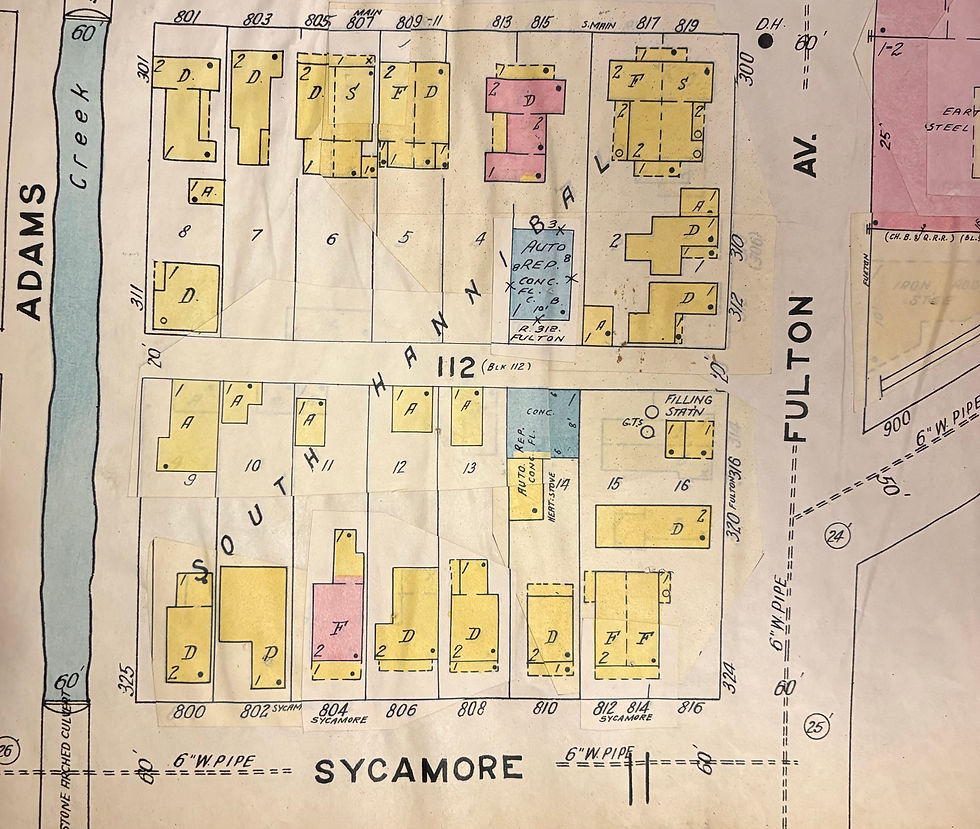
A Sanborn Fire Prevention map, updated in the early 1950s, shows the Cox family’s filling station at 316 Fulton. Next door to the west was the family’s house, at 320 Fulton. You can see the single-story concrete auto shop behind the gas station. A close look at the filling station shows a shadow where the family’s single-story duplex stood prior to the filling station’s construction. Members of the Cox family lived in this portion Fulton Avenue from pre-1912 until mid 1985, some 70-plus years. The filling station and house were torn down following the 1993 flood. Sanborn map shared by Judy Cernea.
Mary Lou Montgomery, Suburban Newspapers of America Editor of the Year, Dailies, 2010, retired as editor of the Hannibal, Mo., Courier-Post in 2014. She researches and writes narrative-style stories about the people who served as building blocks for this region’s foundation. Books available on amazon.com by this author include: “The Notorious Madam Shaw,” “Pioneers in Medicine from Northeast Missouri,” “Hannibal’s ‘West End,’” “Oakwood: West of Hannibal,” “St. Mary’s Avenue District,” and “Live, on stage ion Hannibal 1879: ‘H.M.S. Pinafore.’” Montgomery can be reached at montgomery.editor@yahoo.com Her collective works can be found at www.maryloumontgomery.com


Comments