House, if not hat, has ties to early H&St. Joe fireman

Bobby Martin holds the felt Bowler-style hat she found in the walls of the house at 410 Olive St. The hat was manufactured by the John B. Stetson Co., and had markings that it was sold by the Liepold Clothing Co., 114-116 N. Main St. Photo by Mary Lou Montgomery
MARY LOU MONTGOMERY
A bowler-style hat, manufactured by the John B. Stetson Co., and sold locally by the Liepold Clothing Co., 114-116 N. Main Street, was recently discovered within the plaster and lathe walls of a small house owned by Darren W. and Bobby K. Martin, located at 410 Olive.
The labels on the hat offer clues as to its age:
Markings on the hat reveal that this particular Stetson hat design won the grand prize at the 1900 Paris Exposition; and
The Liepold Clothing Co., operated by Otis and Nathan Liepold, which sold the hat, opened for business on North Main St., on March 7, 1903.
Bobby K. Martin, and her son, Austin Martin, made the discovery of the hat while removing the plaster walls in the second-floor bedroom during a remodeling project. Hidden within the walls, they found not only the man’s hat, but also three pairs of shoes: one man’s and two women’s.
What were these items doing encapsulated within the walls of this frame house?
After researching the topic, Bobby believes the items hidden within the walls were at one time tied to ridding the house of evil spirits. The evil is trapped in the shoes within the walls, she discovered, so it wouldn’t escape into the home.
Her son, Austin, believes the items represent good luck charms.
While the mystery of how and why the clothing items were placed in the walls more than a hundred years ago may never be solved with certainty, one thing is clear: Bobby intends to put the shoes and hat back into the wall, behind the new sheet rock.
She doesn’t want the spirits loose in her house.
Park Place
A recent and related story about this neighborhood - Park Place - tells of the development of the addition which was platted in 1887 by W.B Pettibone and Sarah F. Harris.
The houses in the Park Place development were constructed roughly between 1906 and the 1920s. (Information based upon newspaper articles acquired via newspapers.com.)
But the house at 410 Olive, which the Martins own, has a look reminiscent of earlier times.
Landscape suggests that the house at 410 Olive may have started as a two-room farm house with a stone foundation. The later addition of three rooms, with a concrete foundation, may have been made during the time when neighboring houses were under construction. (As this land was outside of the city limits at the time, research tools are limited.)
Tracing ownership
The Hannibal City Directory of 1903 shows that Walter Q. Brashear, who worked for the Burlington Railroad, was living on Olive Street, near Bird.
In July 1907, Walter Brashear, as owner, transferred the property at 410 Olive to his half sister, Lizzie D. Holman Amsbury, who was living in Longton, Kan. (Perhaps it served as a source of rental income.) The legal description of this property is Lot 12, Block 2, Park Place, Hannibal.
The evidence is circumstantial, but it raises the question:
Could the hat found in the wall at 410 Olive in 2025 have belonged to Walter Q. Brashears, who lived in this house, or nearby in 1903, and who transferred the property deed at 410 Olive to his sister in 1907?
One thing is for sure; if the hat did belong to Mr. Brashear, it belonged to a man of great historical significance.
Railroad run
Walter Q. Brashear was born in 1843, at Mount Grove, Monroe County, Mo., the only child of Wayman L. Brashear, (1814) a cabinet maker by trade, and Caroline Brashear.
Walter’s father died in 1851, and his mother, Caroline, married Edward Holman in 1853 at Davenport, Iowa. Mr. Holman, at first a cabinetmaker, and later an undertaker, died circa 1884.
The Holmans had two daughters together, Walter’s half sisters: Lizzie and Carrie Holman.
According to an article published in the Palmyra Standard in February 1940:
“Mr. Brashear was fireman for Engineer Addison Clark on the famous Hannibal to St. Joseph run on April 6, 1860 when the railroad company sent a train fleeting across the state in the race with the steam boat, the object to see which reached St. Joseph first to convince the government by which way the mail could be gotten to St. Joseph the quickest.”
A steamboat, “was to go up the Missouri river from St. Louis to St. Joseph, the eastern terminal of the Pony Express. With Brashear constantly throwing wood into the firebox of the old locomotive and Clark sending it across the rails of the primitive railroad, the train made a record run of slightly over 4 hours from Hannibal to St. Joseph, beating the boat and winning the contract for the carrying of the government mails.
“As a result of winning the mail contract, the first mail car in the nation was built in Marion County, in the old Hannibal & St. Joseph railroad shops in Hannibal.”
Early rail days
In a letter to the Brookfield Argus and the Linn County Farmer, Brashear shared some remembrances about his early railroading days, published on June 24, 1910. (newspapers.com)
Brashear told the newspaper that he was the first regular fireman for I.N. Wilber in 1864, on the engine Mohegan, No. 17.
“I.N. Wilber fired the Hannibal, No. 2, for George Chapin. I was I.N. Wilber’s first regular fireman in 1864, on the engine Mohegan.
“I afterwards fired the Missouri, No. 11, in 1865, on passenger train, for Ad Clark, engineer,” he wrote.
In 1885, Mr. Brashear’s step father operated a dry goods and notions business at 157 Market, and the family lived at 211 S. Ninth. (They would continue to live in that block for years to come.)
In 1887, Edward Holman was proprietor of Holman and Fritz, and Evan Fritz, practical undertaker, for Holman and Fritz, 317 Broadway.
Lizzie and her husband, George W. Amsbury, left Hannibal for Longton, Kan., where he operated a business there, and served a term as city counselor.
After leaving Hannibal, Mr. Brashear, a veteran of the Civil War, lived in the military home at Leavenworth, Kansas, until 1932, when he went to Longton, Kan., to reside with his sister, Mrs. George W. Amsbury.
He died in Longton at the age of 96, and was buried at Hannibal’s Riverside Cemetery, in Section C2, next to his mother, step-father and half sister, Lizzie.

Three pairs of shoes were discovered tucked away inside the walls of the house at 410 Olive, owned by Darren W. and Bobby K. Martin. In the background are Bobby Martin and her son, Austin. Photo by Mary Lou Montgomery
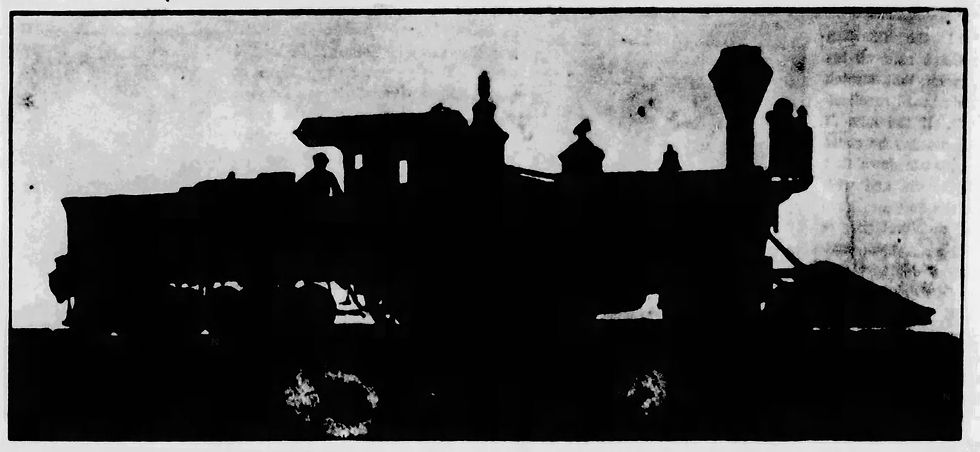
The Pioneer Fast Mail Locomotive, “Missouri.” The stack and fire box were altered in the latter 1860s to burn coal instead of wood. Hannibal Morning Journal, Dec. 29, 1907. newspapers.com

This is a closeup of the Bowler-style hat found within the walls of a house at 410 Olive. Photo by Mary Lou Montgomery
Mary Lou Montgomery, Suburban Newspapers of America Editor of the Year, Dailies, 2010, retired as editor of the Hannibal (Mo.) Courier-Post in 2014. She researches and writes narrative-style stories about the people who served as building blocks for this region’s foundation. Books available on Amazon.com by this author include but are not limited to: "The Notorious Madam Shaw," "Pioneers in Medicine from Northeast Missouri,” “Hannibal’s ‘West End,’” “Oakwood: West of Hannibal,” and “St. Mary’s Avenue District.” Montgomery can be reached at Montgomery.editor@yahoo.com Her collective works can be found at www.maryloumontgomery.com


Comments