J.T. Boyle family, once prevalent in Hannibal, left river town behind

In 1895, John T. Boyle, a Civil War veteran, operated a boarding house at 412 S. Third St., the brick house at left. The boarding house catered to railroad men. In 1912, the name of the street was changed to South Main, and the house number ultimately changed to 804. Photo taken circa 1995 by Steve Chou, prior to the building’s demolition. Reprinted with permission.
MARY LOU MONTGOMERY
For a year or so, circa 1895, John T. Boyle (1834-1919), who attained the rank of Captain during the Civil War, operated a boarding house at 412 Third St., South Hannibal. The same city directory that identified him as a boarding house operator, also listed some 30 railroad men as tenants.
It is improbable that this brick dwelling - the smallest on the block - could have housed that many men at one time. It is more probable that Boyle’s boarding house served as a regular lay-over spot for railroaders who were based in towns at the other end of the line.
The majority - but not all - of the boarders were employed by the Hannibal and St. Joseph Railroad. (By 1900, the Burlington Railroad roundhouse was in use directly across the street.) Other boarders worked for the K-Line.
Two of the young railroaders ultimately became part of the family by marrying John T. Boyle’s daughters: Harry Westlake, who was a fireman on the Brookfield line, married Alice Boyle, the oldest Boyle sibling, in 1897; and James W. Biggs, a brakeman for the K line, married Margaret Boyle in April 1900.
(Tragically, Margaret Boyle Biggs died in October 1902. She was laid to rest in the family plot at St. Mary’s Cemetery, [later renamed Holy Family])
The neighborhood
Third Street - in South Hannibal - extended from Bear Creek to Madison Street (later named Fulton). Third was west of and parallel to the river. (In 1912 the street was renamed Main.)
Third/Main Street is four blocks long; the fourth block - where the Boyle boarding house was located - is the nearest to the Hannibal landmark, Lover’s Leap.
Despite years of Mississippi River overflow along this corridor, the two-story dwelling that served as Boyle’s boarding house would continue to stand for another 100 years, until circa 1995, when remaining buildings in the neighborhood were demolished following the Flood of 1993.
Boyle family
In 1870, John T. Boyle was a 35-year-old locomotive fireman, living in Quincy, Ill., with his wife, Annie Lawler Boyle (1845-1925) , and three young children, Alice, George and James.
A fourth child, Maggie, joined the family while they were still living in Quincy, but by the time their fifth child - Frankie - was born in 1874, they had crossed the river to reside in Hannibal.
Once in Hannibal, five more children joined the family: Eliza, in 1876 (who died a year later); Lillie, born in 1879; Richard Patrick in 1882; John Herbert in 1887 and Sylvester Gorden, in 1889.
Members of the family continued to make their home on Hannibal’s south side until the family matriarch and patriarch moved to Memphis circa 1907.
Alice Boyle Westlake (1865-1952) and the aforementioned Harry Westlake were married in mid-June 1897. After a short wedding trip to St. Louis, the newlyweds settled in Brookfield, where Harry Westlake was employed as a locomotive fireman. Four children were born to this marriage: Mary and Margaret, born in 1902 and 1903 respectively; Francis Monica, born in 1904, who died three months later; and Harry Boyle Westlake, born in 1908.
Harry Westlake Sr., became ill circa 1915, and was hospitalized for some two years before his death.
Alice moved with her children to Memphis, Tenn., in April 1917, to live near her parents and siblings who had previously relocated there. Her husband died in December 1917.
George Boyle (1867-1894). Buried at St. Mary’s Catholic Cemetery, Hannibal.
James E. Boyle, (1869-1958) a retired lumberman, was the last surviving of the 10 Boyle siblings, passing at the age of 88. Born and educated in Hannibal, for a number of years he was employed by Gideon-Anderson Lumber Co., of Gideon, Mo., which is located 125 miles northwest of Memphis. He later moved to Memphis, and worked for the Cole Manufacturing Co.
Margaret Boyle (1872-1900)
Frank J. Boyle (1874-1900). He died at the age of 26, and is buried at St. Mary’s Catholic Cemetery, Hannibal.
Eliza (Lida) Boyle (1876-1877)
Lillie Myrtle Boyle (1879-1884)
Richard Patrick Boyle (1882-1949) went to work as a machinist for the Burlington shops at Hannibal, and by 1920, was following the same profession in Memphis. At the age of 37, he was living with his mother, Annie, sister, Alice Westlake, and her three children, Mary, Margaret and Harry, in Memphis. He died in July 1949 at Omaha, Neb., at the age of 66.
John Herbert Boyle (Bert) (1887-1942) was employed as an apprentice at the Burlington Shops in December 1905, when he fell victim to a remarkable accident. He was in the pit at the side of an engine while his associate was working with the reach bar of the reverse lever just beneath the running board of the engine. The man holding the reverse lever, dropped it, and it struck Boyle a glancing blow on the head. Bert luckily escaped with a scalp wound. He moved east during his lifetime, living in Bridgeport, CT., in 1925. When he registered for military service in 1942, he was a meat salesman for the Oscar Meyer Company, and lived in Washington, D.C.
Gorden Sylvester Boyle (1889-1917) The Boyle family’s youngest child worked as a messenger at the Short Line general offices. In 1904, he was hired for the same position on the Burlington Railroad, later promoted to machinist. By early February, 1908, Gorden was working in the undertaking business in Memphis, Tenn. He died Oct. 19, 1917, in Memphis, of a pulmonary hemorrhage, at the age of 28. His remains were brought back to Hannibal for interment. O’Donnell Bros., was in charge of arrangements, and services were at the Church of Immaculate Conception. Burial followed in St. Mary’s cemetery.
Boarding House
The boarders, as listed in the 1895 Hannibal City Directory.
Felix Allison, engineer H&St. Joe, bds 412 3rd
James Biggs, brakeman K line bds 412 3rd
Peck Bohon, brakeman, bds 412 3rd
Frank J. Boyle, cigar maker, residence 412 3rd
John T. Boyle, bdg, h, 412 3rd
Matthew Collins, brakeman, bds 412 3rd
Lincoln Conklin, fireman H&St. Joe, bds 412 3rd
Daniel Coughlin, fireman H&St. Joe, bds 412 3rd
Henry Derrego, brakeman, bds 412 3rd
Phillip Fetters, eng H&St. Joe, bds 412 3rd
Michael Garvey, brakeman, bds 412 3rd
Geo Griffith, brakeman, bds 412 3rd
John Hall, engineer H&St. Joe, bds 412 3rd
Toney Hays, engineer H&St. Joe, bds 412 3rd
John Iles, brakeman, bds 412 3rd
Len Lane, fireman, H&St. Joe, bds 412 3rd
Bart McDonell, fireman K line, bds 412 3rd
Joseph McDonell, conductor H&St. Joe, bds 412 3rd
Peter Milles, brakeman, bds 412 3rd
William Murphy, engineer H&St. Joe, bds 412 3rd
Joseph Patterson, conductor H& St. Joe, bds 412 3rd
Edward Plum, brakeman, bds 412 3rd
Peter Reilly, engineer H&St. Joe, bds 412 3rd
Barney Smith, switchman, H&St. Joe, bds 412 3rd
J.J. Smith, conductor H&St. Joe, bds 412 3rd
William Teihoff, conductor H&St. Joe, bds 412 3rd
Peter Tilson, brakeman H&St. Joe, bds 412 3rd
William Watts, fireman H&St. Joe, bds 412 3rd
Reuben Wellingham, brakeman H&St. Joe, bds 412 3rd
Harry Westlake, fireman, bds 412 3rd
W. Wilder, conductor H&St. Joe, bds 412 3rd
Richard Willis, brakeman H&St. Joe, bds 412 3rd
Charles Worth, fireman H&St. Joe, bds 412 3rd

1899 Sanborn map, showing the house where the Boyles operated a rooming house in 1895 (circled), in relation to the completed railroad roundhouse just five years later.
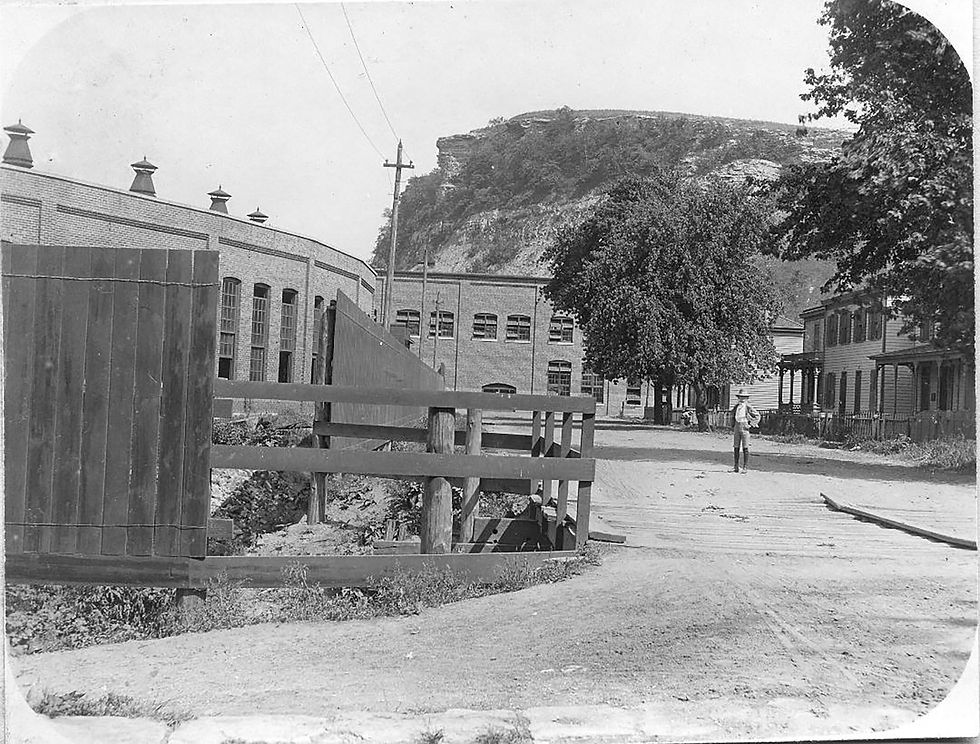
Third Street, South Hannibal, during the early part of the 20th Century. The brick house that served as John T. Boyle’s boarding house in 1895 is in the distance, behind the young man standing in the road, and beyond the tree behind him. A close look at the forefront of this photo shows a wooden bridge, at the intersection of Adams and Third Street, which was later renamed South Main. Anna Schnitzlein photo, contributed by Archie Hayden.
Mary Lou Montgomery, Suburban Newspapers of America Editor of the Year, Dailies, 2010, retired as editor of the Hannibal, Mo., Courier-Post in 2014. She researches and writes narrative-style stories about the people who served as building blocks for this region’s foundation. Books available on amazon.com by this author include: “The Notorious Madam Shaw,” “Pioneers in Medicine from Northeast Missouri,” “Hannibal’s ‘West End,’” “Oakwood: West of Hannibal,” “St. Mary’s Avenue District,” and “Live, on stage on Hannibal 1879: ‘H.M.S. Pinafore.’” Montgomery can be reached at montgomery.editor@yahoo.com Her collective works can be found at www.maryloumontgomery.com


Great story Mary Lou, noting the ages it sure points out how fragile life was in those days.