Palmyra Avenue long home to Kleindienst soda factory

When Caroline Kleindienst died in 1919, her will stipulated that a marker - not to exceed $500 in cost - be placed upon the grave she and her husband share in Riverside Cemetery, and that she be buried in a metal casket. They are buried in Section D18. Photo, taken in 2026, by Mary Lou Montgomery.
MARY LOU MONTGOMERY
Palmyra Avenue was a thriving residential and business district in 1870.
Living and working along the avenue, as listed in the 1871 city directory, were blacksmiths and shoe makers, grocers, a saddler, stone masons, brick manufacturers, teamsters, carpenters, draymen, a broom maker, machinists, butchers, engineers, tailors, painters, railroaders and tobacconists.
Settled along the avenue in 1870 was David Kleindienst, 37, a married father of four, of German descent, who was conducting a soda manufactory on the south side of the road leading from Hannibal to Palmyra.
Published court documents accessed via newspapers.com suggest that Kleindienst may have originally purchased the property, part of Out Lot 85, located along Palmyra Avenue, from Casper Ruff (possibly Casper Ruff Sr., 1806-1873). The Ruff family was long associated with the Ruff Brewing Company, of Quincy, Ill. And like Kleindienst, they were of German ancestry.
The Kleindienst property was located on the south side of Palmyra Avenue, (later renamed Mark Twain Avenue) across the street and a little to the west from what is today known as the Big River Oil Company gas station, 912 Mark Twain Ave. the Kleindienst property had a 205 foot frontage along Palmyra/Mark Twain Avenue.
(The buildings on the south side of this avenue were removed to allow for the widening of the roadway in the mid 1950s.)
Soda manufactory
Carbonated water was the key component in 19th Century soda. It was made via a process of adding carbon dioxide to cold water, which in turn imitates the naturally occurring fizz in mineral water. (Wikipedia)
The Kleindienst business - established as early as 1871 - is believed to have been the first soda manufactory of its kind in Hannibal. It is suggested in newspaper advertisements of the era that Kleindienst made the carbonated water, while the flavoring might have been later added by a retail outlet, via a soda fountain.
One such retail outlet in 1875, “The Gem” was heavily advertised in The Hannibal Clipper newspaper. Called a “popular resort,” the business offered - by the drink - soda water, Ottawa beer, ginger ale and mineral water. It was located on the southwest corner of Main and Broadway, and Isaac Berlin, Hannibal’s city collector, had a financial interest in the business.
Patriarch dies
As the year 1875 ended, there was tragic news for the Kleindienst family. David, the husband, father and breadwinner, died in St. Louis, at the estimated age of 43. Burial followed at Riverside Cemetery, Hannibal.
David Kleindienst and Caroline Eberhart Goldner were married April 28, 1861, in Adams County, Ill. Source: Ancestry.com.
His death left his wife, Caroline, alone to keep the business going and raise their children.
She stepped up and did just that.
For the next 43 years, until her death in 1919, the soda business on Palmyra Avenue continued to fulfill the thirsts of customers both in Hannibal and beyond.
At the time of her death, per stipulation in her will, the business - believed located in the same two-story stone and brick building as when it originally opened, closed.
From her will:
“I direct that my executor, hereinafter named, (August Hofbauer) sell and dispose of the business of soda water manufacturing now carried on by me, together with all tolls, machinery, stock on hand, horses and vehicles and all other personal property used in or connected with said business, and divide the proceeds thereof one half to my said daughter Bertha Paulina Huser and one half to my two said grandchildren, Caroline Minnie Huser and Augusta Elizabeth Huser.”
Goldner family
According to Caroline Goldner Kleindienst’s obituary, published in the Hannibal Evening Courier-Post on March 10, 1919, Caroline and her parents, Christian and Rosena Goldner arrived in Hannibal circa 1847, when Caroline was 8 years old.
In 1859, Christian Goldner, an employee at Garth’s tobacco factory, lived with his family on the westside of Fifth street between Bird and Center.
During the Civil War, he served with the 38th Mo. Infantry.
In 1881 and 1885, he was working for the Soda Factory, now operated by his daughter.
His death came on Dec. 4, 1885, when he was 69 years old. According to Mrs. Kleindienst’s will, both of her parents are buried in the Old Baptist Cemetery.
According to the 1850 census, collected in Hannibal, Rosena Goldner was born in 1812, and Christian Goldner was born in 1816.
Long-time employee
Mrs. Kleindienst singled out a long-time soda factory employee in her will, Thomas Gray, “who has long been my employ, I give and bequeath the sum of One Hundred Dollars.”
Hannibal city directory entries, compiled via the Hannibal Free Public Library’s website, list Thomas B. Gray as a driver for Mrs. Kleindienst in 1909; as a bottler for the same firm in 1911; as a driver in 1912; and as a worker in 1918. Throughout those years he made his home on Pleasant Street.
Thomas B. Gray died in July 1925, at the estimated age of 72. His remains are buried at Mount Olivet Cemetery.
Bottlers
An article in the March 30, 1911 edition of the Hannibal Evening Courier-Post describes Hannibal’s three bottling factories:
"Hannibal can proudly boast of three bottling companies that have sanitary operations and three companies that manufacture none but the purest and best drinks. Each plant is, of course, under the pure food laws and is ready at any moment for the pure food inspector, who is likely to drop around any time and make a thorough inspection of the plant.
"Hannibal soda water manufacturers ship carbonated water within a radius of 100 miles from this city. A great amount of the soda water is sent to towns on the Short Line and the plants also ship considerable into St. Louis and Quincy territory. This speaks well for Hannibal soda water.”
The three plants:
Bluff City Bottling Works, located on North Third Street.
Hannibal Bottling Company, owned by the Pennoyer Brothers, located on North Third Street.
The Kleindienst Plant. “Mrs. Kleindienst who has her factory on Palmyra avenue, has resided in Hannibal for many years and established her business many years ago. She is well experienced in the carbonated water manufacturing and her trade increases each year. This is the oldest soda water factory in Hannibal and has a large and ever increasing business.”
It appears, via a study of available maps and directory listings of the first half of the 20th Century, that the Kleindienst soda water manufactory building was in place until the mid 1950s, when the buildings on the south side of that block of Mark Twain Avenue were removed to make way for the widening of the roadway. The last known owner/occupants listed in available city directories were Roy and Dulsie Clawson.
Residents of the houses in this block of Mark Twain Avenue, 1914, according to the Hannibal City Directory:
800: Joseph M. Grace
804: Mrs. Hattie Lawrence (col)
805: Ambrose Coursey (col)
809: Emmett Church
903: Oliver H. Beal
904: (Not listed)
908: Peter Johann
912: Mrs. Anna Gurry
916: Harry E. Cross
917: Caroline Kleindienst and Henry Huser
918: Harry E. Cross
920: Samuel E. Daugherty
929: Rufus L. Haydon
1000: James Gordon
1009: Andrew J. and John M. Payton, grocer.
1016: (Not listed)
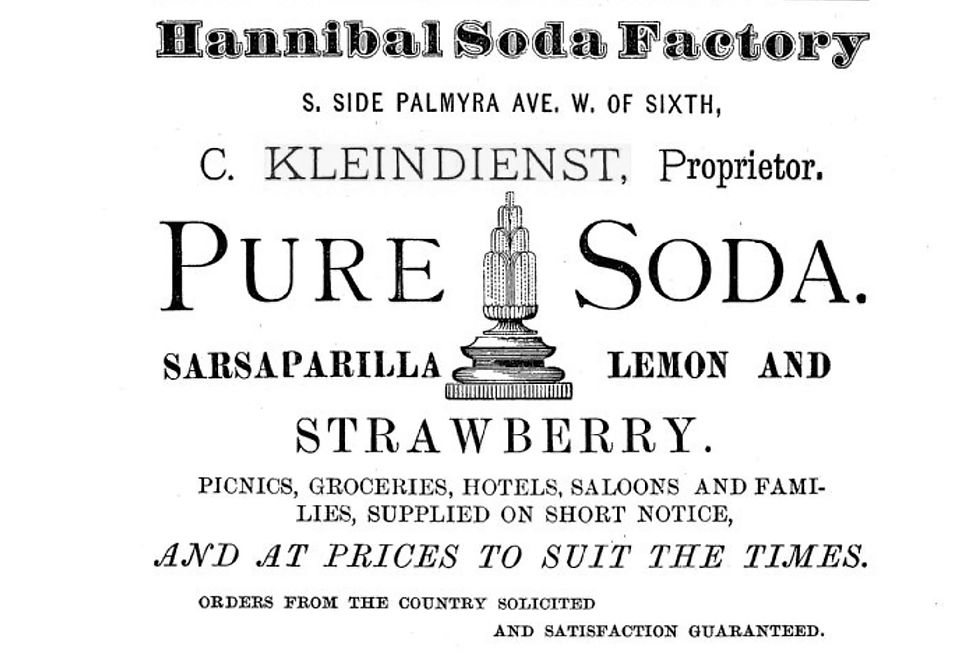
Caroline Kleindienst advertised her soda manufactory in the 1877 Hannibal City Directory. Accessed via Hannibal Free Public Library’s website.

David Kleindienst advertised his soda water manufactory in the 1873 Hannibal City Directory. Accessed via Hannibal Free Public Library’s website.

The stone and brick building which served as the Kleindienst soda water manufactory as early as 1871, was located on the south side of Palmyra/Mark Twain Avenue. This building would continue to serve the soda water manufactory business until 1919. # 2 - The Killians, a family of butchers in 1888, lived at 451 Palmyra Avenue. The house was renumbered 908 in 1912, when it was occupied by Harry, Peter and Henry Johann. The house, vacant but still standing in 2026, is now numbered 908 Mark Twain Avenue. #3 - Palmyra Avenue was renamed Mark Twain Avenue circa 1913. Map based upon 1913 Sanborn Fire Prevention Map.
Mary Lou Montgomery, Suburban Newspapers of America Editor of the Year, Dailies, 2010, retired as editor of the Hannibal, Mo., Courier-Post in 2014. She researches and writes narrative-style stories about the people who served as building blocks for this region’s foundation. Books available on amazon.com by this author include: “The Notorious Madam Shaw,” “Pioneers in Medicine from Northeast Missouri,” “Hannibal’s ‘West End,’” “Oakwood: West of Hannibal,” “St. Mary’s Avenue District,” and “Live, on stage in Hannibal 1879: ‘H.M.S. Pinafore.’” Montgomery can be reached at montgomery.editor@yahoo.com Her collective works can be found at www.maryloumontgomery.com


This article was easy to follow because the information feels simple and naturally written. I visited this Slope 2 Game for rolling ball movement, endless gameplay practice, and smooth control improvement. It helps players build better focus and reaction timing through gameplay.